scale(.26458)'/%3e%3cpath d='m899.078 298.703-24.783-.103 77.876-129.564 90.044 151.173-13.96 21.656-76.699-129.804z' style='fill:lime%3bfill-opacity:1%3bstroke:%236463bd%3bstroke-width:.129099' transform='translate(-221.086 -44.663)scale(.26458)'/%3e%3cpath d='m938.837 232.403 12.357-20.565 79.068 128.9-181.777.102-12.75-22.33 155.778.425z' style='fill:%23f0f%3bfill-opacity:1%3bstroke:%236463bd%3bstroke-width:.129099' transform='translate(-221.086 -44.663)scale(.26458)'/%3e%3c/svg%3e)

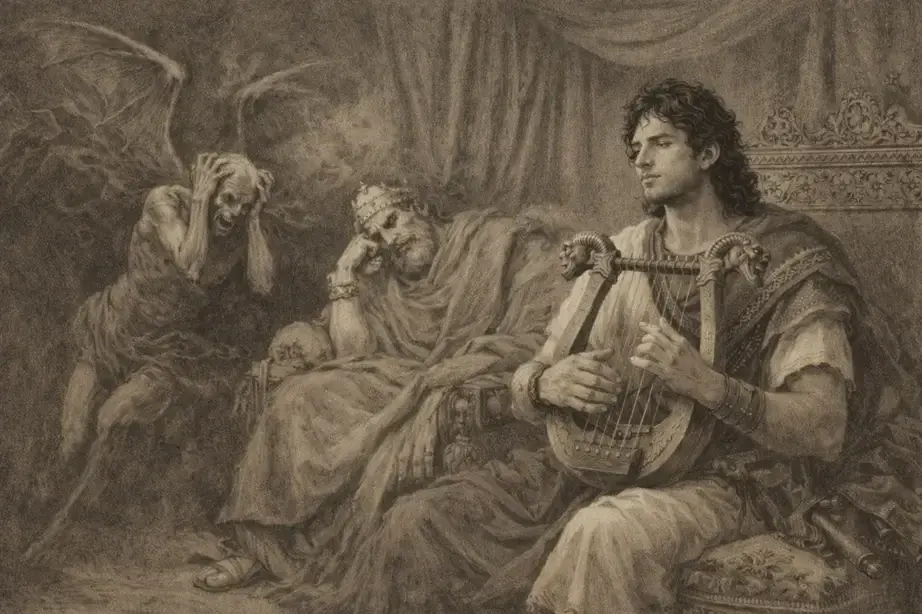
Table of contents
- Introduction
- Song In the Old Testament
- Song In the New Testament
- Song In Spiritual Warfare
- Song From God Himself
- Implications For Today
- Worshipping in Spirit and in Truth
- Modern Day Application
Introduction
On one cold Christmas night in 1914 in the battle torn trenches of WWI, British soldiers overheard something they certainly never expected from their enemy. They heard a chorus of soldiers singing “Silent Night” in German. The British soldiers joined them in the singing, and eventually, a temporary truce was formed, and the two groups of men climbed out of their trenches and played soccer together.1
A Palestinian and Israeli musician started a musical group composed of other Arab and Israeli musicians, some of whom were affected by violence. The group was called “The West-Eastern Divan Orchestra”. Working together, the musicians eventually overcame deep divides and humanized one another. In this case, music became a powerful medium for unity.
The “save the whales” movement in the 1970s was launched by the best selling nature album of all time, Songs of the Humpback Whale. Once we humans realized that whales can make music and actually sing, an entire political movement was mobilized, successfully influencing world policy to prevent the mass slaughter of whales that went on for centuries. All but a few countries today have officially banned whaling.
And then there are the fascinating stories of the mysterious nature of the brain and how it processes music: there have been cases of Alzheimer’s temporarily vanishing when an elderly person begins singing a song, a stroke survivor who lost the ability to speak but not the ability to sing, and those autistic savants who can hear a song once and play it instantly—how can these things happen?
Music is a universal, cross-cultural, and timeless artifact of humanity that moves even the most hardened of us to feel what we can’t feel any other way. Imagine movies without any music. Talk about “awkward silence”! The power of music is appreciated by every social class; from the rich and powerful to those barely making it in street slums; from the towers of academia to the African bush and Amazonian jungles—music’s value has been known since the beginning of time.
The world knows that music is powerful, but as we will soon see, the biblical witness actually takes the power of music to the next level. In this article, I submit that worship-infused music is one of God’s primary mediums for communion with Him. And by extension, it is meant to advance His kingdom on the earth.
Song In the Old Testament
In response to the creation of the universe, we are told that the angels were singing together (Job 38:7).2 Collective singing, therefore, has its origins at the beginning of time! Music is quite literally, timeless and other-wordly, existing before the creation of the world.
One of the most important events in Scripture is the deliverance of the people of Israel through the Red Sea. The significance of this event cannot be understated, but the first response to this event was not a ritual, or sacrifice or offering, but rather a song (Exodus 15:1), with Miriam leading all the women of Israel to dance with tambourines (Exodus 15:20-21).
The largest book of the Bible, Psalms, is mostly lyrics to songs. This should tell us something about God’s heart for song! Take note: the largest book in Scripture, inspired by the Spirit, is a songbook containing the full range of human experience. What might that tell us about God’s heart for music and song?
The Lord, Not David, Instituted Musical Worshippers
The most important king in the long line of Israelite kings was David, and it was he and his commanders who formally appointed musicians. These musicians were appointed “for the ministry of prophesying, accompanied by harps, lyres and cymbals.” (1 Chron. 25:1). Some of those appointed for worship “prophesied, using the harp in thanking and praising the Lord.” (1 Chron. 25:3). This was no small group—all of them were “trained and skilled in music for the Lord—they numbered 288.” (1 Chron. 15:7).
We are also told that King David stationed these musicians in the temple of the Lord. While it may seem like it was David’s idea, in fact, we find that David didn’t come up with the idea for appointing musical worshippers at all—it was a command of the Lord through the prophets:
He stationed the Levites in the temple of the Lord with cymbals, harps and lyres in the way prescribed by David and Gad the king's seer and Nathan the prophet; this was commanded by the Lord through his prophets. So the Levites stood ready with David's instruments, and the priests with their trumpets.
(2 Chron. 29:25-26, emphasis mine)
It was the Lord Himself who directed the prophets to institute an ongoing ministry of prophetic worshippers, trained musically. Musical worship, therefore, is not just a cultural practice, ritual, or temple-regulation, but a divinely ordained sacrament. This ordination continues to this day. Musical worshippers today stand on the shoulders of generations of faithful believers who have walked the well-worn path of ministry to the Lord—prophecy, praise, and deep connection with God. Many of the psalms were written by Asaph, one of the main worship leaders. In Asaph and David’s life, you can’t help but notice that these men bared their hearts before the Lord. The depth of their connection with the Lord seems to have been far before their time. They embodied what many of us still struggle to do: approach the throne of grace with confidence to receive mercy and grace in our time of need (Heb. 4:16). They regularly received their needs from the Lord with childlike faith. These men were men of confidence and authenticity, but also reverent fear.
The Power of The Spirit Displayed Through Worship Music
After formal musical worship in the Levitical priesthood was instituted, we find one of the more dramatic manifestations of God’s presence:
All the Levites who were musicians—Asaph, Heman, Jeduthun and their sons and relatives—stood on the east side of the altar, dressed in fine linen and playing cymbals, harps and lyres. They were accompanied by 120 priests sounding trumpets. The trumpeters and musicians joined in unison to give praise and thanks to the Lord. Accompanied by trumpets, cymbals and other instruments, the singers raised their voices in praise to the Lord and sang:
"He is good;
his love endures forever."
Then the temple of the Lord was filled with the cloud, and the priests could not perform their service because of the cloud, for the glory of the Lord filled the temple of God.
(2 Chronicles 5:12-14)
The prophet Elisha was apparently quite aware of his need for music in order to connect with the Lord. One time, he seemed quite bothered when the king wanted him to prophesy. Reluctantly, he gave in, but not without demanding that a harpist come and play for him (2 Kgs. 3:15). “While the harpist was playing, the hand of the Lord came on Elisha.” (v. 15).
The first king of Israel, Saul, was anointed by the prophet Samuel, but Samuel told Saul some pretty crazy things that would happen to him that day. Samuel told Saul he would see “a procession of prophets coming down from the high place with lyres, timbrels, pipes and harps being played before them, and they will be prophesying. The Spirit of the Lord will come powerfully upon you, and you will prophesy with them; and you will be changed into a different person.” (1 Sam. 10:5-6). Again, prophecy and worship music go hand in hand in the Old Testament, and shows us that God’s presence is revealed in greater measure through it.
David was speaking from direct experience when he wrote, “…you are holy, enthroned on the praises of Israel.” (Psalm 22:3, ESV).
Song In the New Testament
Biblical scholars actually believe that some portions of Scripture in the New Testament are actual fragments and/or direct lyrics of songs sung by the early church!
Among these passages are Philippians 2:6-11, Colossians 1:15-20, 1 Timothy 3:16, and Ephesians 5:16.3 There is strong evidence that these passages were lyrics to songs. If that is the case, then not only is the largest bible book a book of songs, but it bleeds over into in the New Testament!
Beyond that, there are numerous passages in the book of Revelation that vividly reveal God’s people worshipping Him in heaven, but not just speaking praise, but singing with musical instruments. In John’s trance, he heard the sound of “harpists playing their harps” (Rev. 14:2). The four living creatures, and all 24 elders had a harp (Rev. 5:8). When he saw those who were killed for their faith, they each “held harps given them by God” (Rev. 15:2). Interesting, that God would give each of these martyrs a harp.
On more than one occasion, Paul exhorted churches to sing new songs from our hearts (Eph. 5:19). It is therefore something every believer can do. He taught that whenever believers meet, people may have a song to sing in order to build up the body (1 Cor. 14:26). Paul even expected his congregations to be using song as a form of teaching and exhorting (Col. 3:16).
We also shouldn’t forget that singing in the Spirit (tongues) was something Paul practiced (see 1 Cor. 14:14-15). Even when we don’t have words to sing, we can sing through the gift of tongues, provided we are in the right setting.4 It is a beautiful experience to commune with the Lord like this!
Over the years, I would come across people who would often say that they had a hard time connecting with God through music. While I certainly want to respect everyone’s preferences, the more I see God’s intentionality around music in Scripture, the more I am beginning to think that every believer actually needs to be equipped and trained to connect with God through praise and worship. I’ve only ever seen reserved or shy people experience deep freedom in Christ when they dance and sing to God.
Song In Spiritual Warfare
Biblically, music can affect more than just the natural world, but even the spiritual world. In a fascinating account in the OT, we find that somehow the ancient King Saul’s servants knew that the solution to demonic affliction was musical, almost as if it was common knowledge:
Saul's attendants said to him, "See, an evil spirit from God is tormenting you. Let our lord command his servants here to search for someone who can play the
lyre. He will play when the evil spirit from God comes on you, and you will feel better."
(1 Sam. 16:15-16)
They summoned David, the one who would eventually take Saul’s place. They were right:
Whenever the spirit from God came on Saul, David would take up his lyre and play. Then relief would come to Saul; he would feel better, and the evil spirit would leave him.
(1 Sam. 16:23)
What is notable about this example from Scripture, is that there is no indication that words were being sung by David, it was rather the mere sound that had a supernatural impact.
One Israelite king, Jehoshaphat, exemplified radical faith by choosing to fight his battle using praise instead of violent warfare. Some neighboring tribes rose up to wage war on Israel. Having received a prophetic word from God to face these people and that the Lord would bring a victory, he decided to appoint worshippers to go out to battle as the front of the army (2 Chronicles 20:21).
We are not given exact details of how this happened, but “As they began to sing and praise, the Lord set ambushes against the men of Ammon and Moab and Mount Seir who were invading Judah, and they were defeated.” (v. 22). What is notable about this instance is the fact that the Lord “set ambushes” when they began to sing and praise. We tend to view the biblical narrative purely in natural terms, but the people of Israel understood that supernatural forces were at play behind physical warfare,5 seen most clearly in the case where the prophet Elisha was surrounded by a physical army, but saw that a massive angel army was around him for protection (2 Kings 6:15-17)
So when we see that the Lord “set ambushes”, Israel would have understood that the Lord was spiritually and physically fighting for them in response to their praise. When we praise God, He goes to battle for us, fighting off the powers of darkness and the physical world is altered. The Lord brought about a victory similarly through a trumpet blast and shout, causing the walls of Jericho to fall down (Joshua 6:5).
I think Paul taught this praise-as-warfare principle when he said that thankfulness and petition leads to peace of mind (Philippians 4:6-7). This peace is not just mere tranquility, but rather that this peace guards our hearts. This Greek word for “guard” (phroureō) carries some fascinating meaning: it carries with it the context of authoritative force (i.e. military or custodial contexts).6 The metaphor is that of an external force; it is not our own effort that defeats the enemy, but the peace of God goes ahead of us with militant force. And it is received via thanksgiving and praise.
Some Personal Testimonies of Praise and Worship in Spiritual Warfare
The average Western person might think it is crazy to believe that music can change the spiritual world. But as believers with a biblical worldview, that’s not really an option!
Suicidal Thoughts Eliminated I had struggled with suicidal thoughts starting in middle school, although I never really understood why. I never could point to some drastic circumstance that would have made someone think suicidal thoughts. They were just there, thoughts like “Throw yourself off that cliff”, and similar thoughts. I usually just thought to myself, that’s weird. Thankfully, these thoughts weren’t overwhelming. Eventually, I began to understand that these intrusive thoughts were probably demonic (duh!). But how does music play into this? I realized around 20 yrs after middle school that the song I loved as a kid, Chop Suey by the band “System of a Down” was about suicide. I used to play that song full blast and sing it. I knew the word suicide was in there, but I just shrugged it off as a kid-o. When I finally realized this through my wife, I went to the Lord and repented for shrugging off suicide. God was granting me repentance leading to a knowledge of the truth so I could escape the trap of the devil (2 Tim. 2:25-26). After that, those thoughts never returned.
Evangelism and God’s Power, Story 1 I was once on a church trip to a country in the Middle East where we were going to share the gospel. Our strategy was simple: worship in a circle on a large boardwalk next to the sea to gather a crowd, transition to a drama presentation of the gospel, and then pray for people. There is one story that I may never forget. After we went through our whole cycle of worship/drama/gospel, there was one man who was looking simultaneously concerned, and emotionally vulnerable at the same time. He was trying to get the attention of one of our teammates. The look on his face is burned in my memory. He was trying to ask someone on our team who didn’t speak Arabic a question. Finally a translator came and helped my teammate, but I couldn’t hear them since there were so many people around us. Because of how concerned and soft-hearted he looked, I went over and talked to the translator to ask what was happening. I was right next to the Arab man, and the translator told me, “this man is asking why, when he walked up to a circle of people playing guitar, that something like stones fell off his heart.” It is notable that this man “felt” this without even knowing any English (we were singing in English). We prayed for him, and he was crying. He was feeling emotional before he even had an answer to his question, which shows that he was experiencing the power of God.
Evangelism and God’s Power, Story 2 This is not actually my story, but is an amazing story. I was once discipled by a worship leader who told me a fascinating story about from his spiritual mentor. His spiritual mentor was on a church trip to share the gospel in a remote region (I forget where). Their team was approaching a village they wanted to target, but upon approaching it, they saw villagers at the edge of the village, looking at them with dangerous and eerie looks on their faces. It was clear they were not welcome there. The team resolved to go up on a hill near the village to worship and pray. They came back down the hill and as they approached the village again, the villagers were completely different, welcoming them in, and they got to preach the gospel to them. Something in the supernatural realm had changed via praise and worship!
Song From God Himself
The most clear example in Scripture of God Himself singing is found in Zephaniah 3. Our heavenly Father is one who will “exult over [us] with loud singing” (Zeph. 3:17, ESV). Not just singing, but loud singing!
In addition to the Lord Himself singing, the Spirit of God actually inspires His people with song (Psalm 40:3). He doesn’t just sing, but He loves it so much that He also wants to teach us to sing like Him. Jesus took part in singing songs (Matt. 26:30). The author of Hebrews actually describes Jesus as one who sings in our midst (Heb. 2:11-12), which might be a fulfillment of Zephaniah 3:17 (maybe even Jesus rejoicing in the Spirit over childlike faith in Luke 10:21, too). Our God is a God who sings! What might that change for you and how does that impact your prayer life, and the way you relate to Jesus, the Spirit, and the Father?
Implications For Today
In the New Testament, Jesus announced that the kingdom of heaven was at hand. If the Lord is enthroned on the praises of His people (Ps. 22:3, ESV), then God’s kingdom is, in part, meant to be revealed and extended through praise and worship. Everywhere God’s kingdom is moving, praise and worship should be present, whether that’s in church, at your home, your workplace, or in another nation. Praise is inextricably bound to the kingdom of God.
More than that, worshippers are not just members of religious institutions, but worship teams are actually described as God’s own “procession” (Ps. 68:24-25). They are appointed by Him. How does the fact that God appoints praise and worshippers change the way you view musical worship?
Worship Music is a Divinely Ordained Mode of Communion With God
God wants us to drink from His river of delights, and worship music is one of those delights. It is something our Father has given us for our enjoyment (1 Tim. 6:17). He desires to inspire new songs in us and through us that draw us and those around us into beholding the glory of God.
Beholding the glory of God is not just an abstract idea, it is the very mode of transformation:
And we all, who with unveiled faces contemplate the Lord's glory, are being transformed into his image with ever-increasing glory, which comes from the Lord, who is the Spirit.
(2 Cor. 3:18)
It is not the sound itself that we are after, and nor is it the sound by itself what connects us to God; it is the anointing of the Spirit on the sound offered to Him. Sometimes in the charismatic world, there is talk about “frequencies” that we need to “tap into”. I have heard many “prophetic” ministers speak of these “frequencies”, and it makes it seem like soundwaves can become some sort magical substance. It is very close to new age thinking that can be dangerous, since it gets us to focus our hearts more on the sound instead of God Himself. When David played his instrument, it is true that the mere sound of his lyre sent the evil spirit away from Saul. But we should also remember that another time he played for Saul, his playing didn’t work at all (1 Sam. 18:10-11). God is in charge of the fruit, no matter how well we play.
So instead of worship music having some sort of magical frequency, Scripture shows us that God responds to and energizes musical sound offered to Him, but it is He who is doing the energizing. I’ve personally experienced the power of the Spirit with low-skilled instruments being played and bad singing, and experienced absolutely nothing in a more sophisticated, production-grade worship sets. Why? Because the Spirit of God is the one who is the one in control. While we certainly should bring our best to the Lord, and are even commanded to use instruments to “play skillfully” (Ps. 33:3), we must remember that apart from the Lord, we can do absolutely nothing (John 15:5).
This has real implications for churches and worship teams. Particularly in America, which is probably the most performance-based culture in the world, we must remember that production quality is nothing; the Spirit is everything. America arguably has the most skilled worship teams on earth. But the Spirit of God is moving in power in other nations at a far faster pace than in America. China has no huge, traveling worship teams that sing in stadiums, but the church is exploding there. The same is true across the world. What matters more is the presence of the Spirit.
Paul taught that “wisdom and eloquence” have the real potential to rob the cross of Christ of its power (1 Cor. 1:17). The Lord once said, “Not by might nor by power, but by my Spirit” (Zech. 4:6). We should remember that Paul was not considered an eloquent speaker (2 Cor. 10:10). When accused of these things, Paul responded by boasting in his own weakness as evidential proof of God’s power; in other words, he wasn’t supposed to be eloquent. He was supposed to just be a willing vessel, focusing on demonstrating the Spirit’s power, and none of his own (1 Cor. 3:1-5). As a musician myself, it is tantalizing to put stock in my skill level, and I certainly have been guilty of this before. We should never put stock in our skill level, but be constantly aware that we are radically dependent upon the Spirit, more than we could ever know. And this dependency is the faith that Jesus marveled at and activated miracles and God’s kingdom. There is a joyful expectancy that is available for those whose character is shaped by childlike and shame-free dependence on God. Results don’t matter when you’re dependent. As the Psalmist himself once declared, “Some trust in chariots and some in horses, but we trust in the name of the Lord our God” (Ps. 20:7). And even more clearly,
No king is saved by the size of his army;
no warrior escapes by his great strength.
A horse is a vain hope for deliverance;
despite all its great strength it cannot save.
(Psalm 33:16–17)
All of these truths must impact every church’s worship team on a fundamental and practical level; practical processes and procedures must be infused with these values, in addition to the spiritual soil of each heart.
Is it true that worship is not about music?
Yes, worship is about God alone. Yes, worship is about obedience, not just musical performances. While I understand the good intentions behind this statement, we should not forget that God has the right to ordain particular practices and modes of worship. In this short overview, we’ve seen that God has ordained musical worship. Since the Lord had David institute worshippers, musical worship has never stopped, and will never stop, even after the Lord returns.
I submit that music/singing is the most biblically prescribed “mode” of thankfulness and praise we have in Scripture, and in church history. It literally exists from Genesis 1:1 (the angels were singing at creation) and is commanded throughout the whole of Scripture. While Christian denominations differ on a lot of things, all denominations implement some form of music in church practice, which is proof enough of the Spirit’s decision for thankfulness to God to be expressed through creative musical expression.
Is it true that worship music can “emotionally manipulate” people?
The charge that music can be emotionally manipulating is something that atheists, and even conservative Christians, might say. The phrase “emotionally manipulate” feels very negative, as if certain frequency ranges can “manipulate” people’s will.
The Valid Concern
Some Christians are concerned that people may confuse their own emotions with the Spirit’s work and be led astray. This is a good and valid concern to have (unless you fall prey to over-analyzing yourself, like me!). The concern is also a response to megachurch scandals and performance-motivated worship that has proven to be a reality in the Christian world.
What is really behind the question of emotional manipulation is less about music itself and more about the motive of the people running the worship sets. Does a worship leader or team play excellently in order to attract crowds and build popularity and/or brand recognition? Or do they do it out of heartfelt and genuine desire to shepherd the congregation, minister to the Lord, and commune with God?
Worship music in and of itself is merely a tool to be used by God’s people; a tool that can be used for the glory of God, or for the glory of man. And as this article has attempted to show, it is not merely a man-made tool, but a God-ordained one. Any tool the Lord gives can be abused; how many people have used the Bible itself to “emotionally manipulate” people? Christians have always ended up abusing some gift from God for self-serving purposes, but the fact that Christians do this cannot and will never delegitimize the graces and commands that God has chosen to give His people.
While it is good to think through whether or not our emotions are/are not being influenced by the Spirit, there is also the danger of fleshly introspection that exalts the self just as much as worshipping feelings does. Worshipping emotions on the one hand, and over-analyzing yourself on the other, actually both end up exalting the self above God’s Spirit. Anxious introspection masquerades as wisdom, when in reality, it is me attempting to assert control of my own growth in Christ, instead of joyfully trusting that the Spirit will lead me into all truth (John 16:13). One person needs to stop over-analyzing and let themselves feel. Another needs to check their emotions, and take a more objective look at their feelings. It would be wise to know which one of these pitfalls you gravitate towards.
The False Concern
While space doesn’t allow for fully addressing the “manipulation” accusation from atheists, I’ll address it from the conservative Christians. I’ll say first that for Christians, believing God doesn’t use music or sound as a mode of communication, presence, and power, is simply not an option if you take the Bible seriously. It is to be expected. To re-iterate, the largest book of Scripture is actually poetry with every range of human emotion expressed in the context of communion with God. If Christians claim that worship music is “emotionally manipulating” people, I would fear that my brother or sister in Christ may be a victim of bad biblical teaching, or fear and control. It is not always easy to let oneself completely feel all of one’s emotions, and people can be afraid of their own feelings. Multiple empirically grounded, peer-reviewed studies on the fear of emotion have confirmed this to be a reality.7
Worshipping in Spirit and in Truth
While speaking with the Samaritan woman at the well, Jesus explained,
Yet a time is coming and has now come when the true worshipers will worship the Father in the Spirit and in truth, for they are the kind of worshipers the Father seeks. God is spirit, and his worshipers must worship in the Spirit and in truth.
(John 4:23-24)
The immediate context of this passage is location. The Samaritan woman told Jesus that worship must take place in Jerusalem (v. 20), but Jesus then explains that the time is coming when where someone worships will no longer matter (v. 21). So when Jesus says that we must worship in the Spirit, his first goal is to explain that we are not bound by a geographical location, but we will worship through God’s omniscient presence by the Spirit. The Jerusalem Temple used to be the epicenter of the worship of God on earth. No longer.
In the Spirit
But the phrase “in the Spirit” for an ancient Jew hearing Jesus teach would have stood out deeply.8 When the Spirit of God rushed upon or filled someone in the Old Testament, a huge variety of things happened: the Spirit empowered one man with artistic genius (Ex. 31:3), dramatic prophecy (Num 24:2), and strength in battle. The prophet Samuel told Saul that when the Spirit of the Lord comes upon him, he would prophesy, and that he would “…be changed into a different person.” (1 Sam 10:6).
The Spirit of the Lord could inspire righteous anger (1 Sam. 11:6), and gave the ancient prophets dramatic trances and visions. The prophet Ezekiel fell facedown when having a vision (Ezekiel 1:28). Another time, he experienced the glory of the Lord and fell facedown again (Ezekiel 3:23), similar to how the priests assigned to worship duty could not stand because the glory of God was so strong (2 Chronicles 5:14). There is in fact, biblical precedent for “falling down” or “falling over” in the presence of God. John did (Rev. 1:17), the 24 elders did (Rev. 4:10-11), and even the angels fell on their faces in worship (Rev. 7:11).
One time Saul was bent on murdering David, and sent men to kill him (1 Sam. 19:19), but a group of prophets were there prophesying with Samuel, and the Spirit of God came upon the men and they began prophesying! Saul tried with another group, but the same thing happened (v. 20). Finally, Saul went himself, but the Spirit came upon him and he also started prophesying. Oddly, the Scripture says that Saul “…lay naked all that day and all that night.” (v. 24). That is what can happen when the Spirit comes upon people; no heart is too hard for God. Side note: the Scripture doesn’t say that God made Saul get naked! That was Saul’s response. When people experience God in dramatic ways, sometimes people observe their response and confuse it with God, and people get scared. More on this later.
So Jesus most likely used the phrase “in the Spirit” to teach us that true worship must be empowered by the Spirit and include the full range of the Spirit’s power, unafraid of dramatic experience and emotion, but recognizing that these experiences are to be expected and desired, and the Spirit is now our inheritance! Paul taught that we all “…have access to the Father by one Spirit.” (Eph. 2:18) and that “…we were all given one Spirit to drink.” (1 Cor. 12:13).
This is not just a mere byproduct of salvation, but us being united to Himself as sons and daughters by the Spirit was the Father’s deep delight and will (Eph. 1:5), his predestined plan, something that was in His heart before the foundation of the world (Eph. 1:5). The Father supplies the Spirit without measure (John 3:34)! The Father is not content to just give you a little. According to Jesus, rivers of living water will flow from within us (John 7:38). Rivers, not trickles! Just look at His desire for you:
They feast on the abundance of your house; you give them drink from your river of delights.
(Psalm 36:8)
You make known to me the path of life; you will fill me with joy in your presence, with eternal pleasures at your right hand.
(Psalm 16:11)
One translation of Isaiah says, “With joy you will drink deeply from the fountain of salvation!” (Isa. 12:3).
In Truth
But Jesus also said to worship “in truth”. The implication is that worship can take place in deception. We must not worship in deception or falsehood. The fact that Jesus presents a dichotomy (in the Spirit and in truth), it seems like Jesus knew that Spirit-empowered worship can provide the opportunity for hyper-emotionalism, that is not grounded in true worship, but the flesh. He is not saying that the Spirit and the truth are somehow separate (the Spirit is the Spirit of truth). This is why He is probably talking about the action of worshipping God: through the Spirit, and in truth.
I can’t help but think of other times Scripture attaches the phrase in the truth in order to communicate the importance of authenticity and purity, which implies that there is a way to do something not truly, or in our modern way of saying things, acting like a “fake”. We don’t want to fake anything in our worship.
Paul taught that true love is genuine (Rom. 12:9, ESV), which means that the apostle was aware and probably experienced people who outwardly love, but weren’t genuine. One time Paul taught Christians in slavery to obey their masters to win their favor, but “…not by the way of eye-service, as people-pleasers, but as bondservants of Christ, doing the will of God from the heart…” (Eph. 6:6, ESV). We serve and worship God because He is worthy, not so we can get something.
The apostle John taught the same thing; we should “…not love with words or speech but with actions and in truth.” (1 John 3:18). True love for God and neighbor always “…rejoices with the truth.” (1 Cor. 13:6). While we should always strive to speak the truth in love (and will be far more effective if we do), sometimes we need to rejoice with the truth regardless of how we receive it. Love refuses to conditionally rejoice with the truth.
Worshipping God in the truth perhaps is best captured by the Lord’s word to Isaiah:
These people come near to me with their mouth and honor me with their lips, but their hearts are far from me. Their worship of me is based on merely human rules they have been taught.
(Isaiah 29:13)
We can all honor God with our lips, but the real question is where is our heart? The fact is, you can be hiding from God in the middle of a powerful worship service. The Father calls to us as He did to Adam, “Where are you?”
Learning From David and Asaph
Recall that David and Asaph were men of deep honesty, and were models of what it means to worship God in Spirit and in truth. Their writings show us that they would have responded to the Father’s question with a resounding “I’m right here!” Their example in the Psalms shows us worshippers who acknowledged their own problems, but didn’t let their problems distance themselves from the One who had the power to solve them. They didn’t let shame prevent them from the presence of God; seemingly nothing could get in their way. God never cast them off, never rejected them in their deepest sins, and wanted their process to be on display for eternity; God put their process in Scripture as an example for us to follow.
David and Asaph had an objective view of their own sin, and a right understanding of God’s holiness and His unending love. We want to be people who have a deep, reverential, and fatherly respect for God as the ruler of all, but also are able to be deeply aware of His deep tenderness and deep affection (Phil. 1:8, Isa. 63:15, Luke 1:78, Hos. 2:14-16, Jer. 31:3, Isa. 49:15). David and Asaph knew both. They were men who deeply respected the word of God, but weren’t satisfied with form, ritual, or lifeless worship. They wanted more; they were desperate for God’s nearness. But they understood submitting to God’s kingship, and trusted it more than their own desires, but expected a good shepherd’s nearness.
Modern Day Application
If we want to worship in the truth, that means we need to deeply understand what we are singing. If we are asking the Lord to purify us, are we able to understand that this might bring a lot of pain into our lives? Do we really want that, and we really prepared to go through harder situations? Singing “I want to be tried by fire” is a very bold thing to sing, and you shouldn’t sing it unless you really mean it. We want to be grounded in the word of God, singing it back to Him, having our minds saturated in the truth of who He is.
If we want to worship in the Spirit, that means we need to deeply engage our entire being with what we are singing, spirit, soul, and body. We want to bring our highest expectation and faith for who He is in our midst, what He wants to do in us, and for us. We need to step out in faith, get bold with God, and believe Him for the impossible, not hiding our emotions and true selves before God.
We need to follow David and Asaph’s example. Christian culture today tends to either over-emphasize, or de-emphasize emotion and passion. We need to get desperate for God, acknowledge the truth, and believe God for the impossible. We can’t be satisfied with our lives when there is so much more to know and experience in the presence of God. We talked a lot about the Spirit’s activity in the Old Testament, but we must realize that those were only foretastes of what was to come. The Spirit was prophesied to come upon all flesh! (Joel 2). We should therefore be expecting supernatural experiences and power encounters with God, and longing for them. We shouldn’t be surprised by them, but in fact, we should be surprised if the power of the Spirit is not visible. You see, for David and Asaph, it was not enough to go through the motions. They were men who saw the true purpose behind God’s prescribed laws, rhythms, and routines, seeing that it was to lead them to God and His messiah (Gal. 3:24). We must believe that constant communion with God is not only possible, but can become the norm for us, if we’d only believe and seek Him with our whole heart. We need to build a supernatural history with God so we know what is coming from Him, ourselves, or from the enemy. It is not unbelief to ask God to give you signs and a supernatural history with Him, and you can have a deep confidence and dynamic relationship with the Lord, being grounded in truth and filled to overflow with the Spirit!
Notes
Footnotes
-
See Christmas Truce: The Western Front, December 1914. ↩
-
In context, the “morning star” language refers to angels. See Dr. Michael Heiser’s The Unseen Realm p. 85. In Isaiah 14:12-15, we read of Satan being called the morning star, and that he believed he was greater than all the “stars of God”. In the context of Job 38, morning stars are coupled with “the sons of God”, who are divine beings created by God. ↩
-
Among the scholars who support such a view are F.F. Bruce, Gordon Fee, and Ralph P. Martin. ↩
-
Paul wanted people to refrain from speaking in tongues if non-believers were present in the meeting. This, however, shouldn’t prevent us from singing corporately in tongues if the meeting is composed of only believers. ↩
-
See my article on the meaning of chaotic waters in Scripture for a fuller discussion on spiritual warfare in the OT. ↩
-
https://www.blueletterbible.org/lexicon/g5432/niv/mgnt/0-1/ ↩
-
https://www.blueletterbible.org/search/search.cfm?Criteria=Spirit+of+God&t=NIV#s=s_primary_0_1 ↩